
Are We Raising Children or Managing Schedules? A Parent’s Guide to Slowing Down Childhood
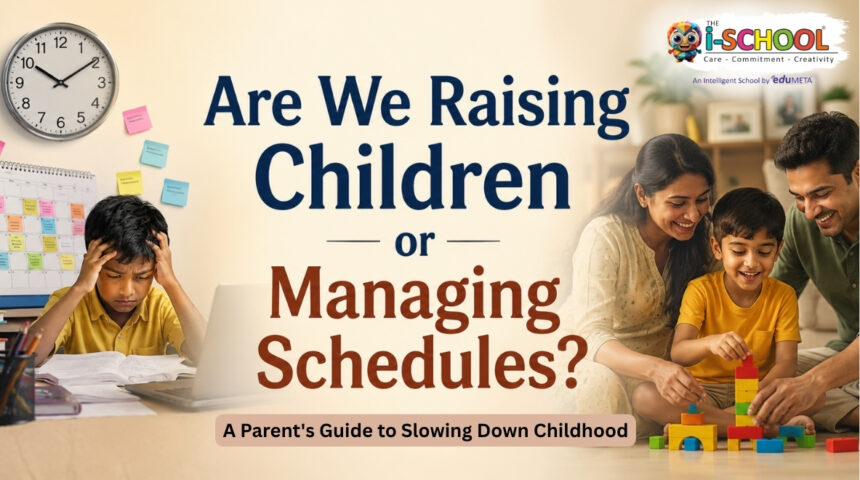
Take a look at a typical weekday for many young children.
Wake up.
Get ready.
School.
Activity class.
Homework.
Dinner.
Bedtime.
Repeat.
Modern childhood has become remarkably busy.
In many families, children’s calendars now look almost as packed as their parents’.
The intention is understandable.
Parents want to provide every opportunity possible.
But in the process, an important question is emerging:
Are children truly benefiting from being constantly busy?
Or are they losing something equally important?
Childhood Was Never Meant to Be a Race
Parents naturally want their children to succeed.
However, success in early childhood is often misunderstood.
Many people assume development means:
- Learning faster
- Reading earlier
- Completing more activities
- Achieving more milestones
But development isn’t a competition.
Children grow best when they have time to:
- Explore
- Wonder
- Imagine
- Play
- Make mistakes
Growth requires space.
The Power of Boredom
Few words worry modern parents more than:
“I’m bored.”
Yet boredom isn’t necessarily a problem.
In fact, boredom often becomes the starting point for creativity.
When children are not constantly entertained, they begin to:
- Invent games
- Create stories
- Solve problems
- Explore ideas
Many childhood discoveries begin with moments of unstructured time.
Why Free Play Is Becoming Rare
Free play once happened naturally.
Children spent hours:
- Building forts
- Pretending
- Exploring outdoors
- Creating imaginary worlds
Today, free play often competes with:
- Screens
- Structured activities
- Busy schedules
As a result, opportunities for self-directed learning are becoming less common.
What Children Actually Need Most
Before age six, children need experiences that support:
Emotional Security
Children learn best when they feel safe.
Strong Relationships
Healthy relationships create confidence.
Curiosity
Curious children become motivated learners.
Communication
Language develops through interaction.
Independence
Small responsibilities build self-belief.
The Hidden Value of Unhurried Childhood
Children need moments where nothing special is planned.
Moments to:
- Observe insects
- Build with blocks
- Draw pictures
- Ask questions
- Imagine possibilities
These experiences may appear simple.
Yet they support critical developmental skills.
What Preschools Can Teach Parents
Quality preschools understand something important.
Children do not learn best under pressure.
They learn best through engagement.
The strongest preschool environments balance:
- Structure
- Freedom
- Exploration
- Guidance
This balance creates confident learners.
Signs Your Child May Need More Breathing Space
Consider whether your child:
- Appears constantly tired
- Shows resistance toward activities
- Has little free play time
- Rarely spends time outdoors
- Seems overwhelmed by schedules
These may be signs that a slower pace could be beneficial.
Creating More Space Without Doing Less
Slowing down doesn’t mean eliminating opportunities.
It means choosing meaningful experiences over constant activity.
Parents can:
- Prioritize family conversations
- Encourage outdoor exploration
- Allow free play
- Reduce unnecessary commitments
- Create screen-free time
Small changes often make a significant difference.
How THE i-SCHOOL Supports Balanced Development
At THE i-SCHOOL, learning is designed around the whole child.
Children are encouraged to:
- Explore
- Create
- Communicate
- Collaborate
- Build confidence
Because childhood should not be rushed.
It should be experienced.
Final Thoughts
Years from now, children are unlikely to remember every class they attended.
But they may remember:
Building something unexpected.
Making a new friend.
Discovering a butterfly.
Listening to a story.
Feeling proud of something they created themselves.
Sometimes the greatest gift we can give children is not more opportunities.
It’s more time to be children.