
Why Pretend Play Matters: 7 Skills Preschoolers Build Through Make-Believe
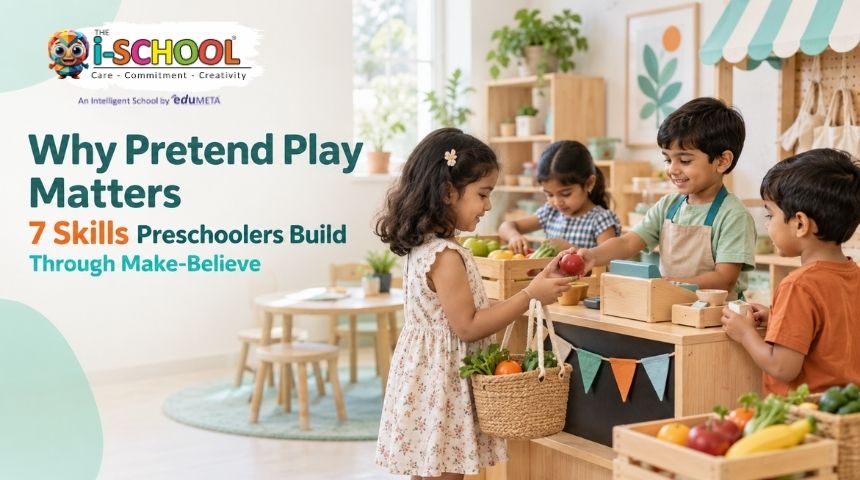
A cardboard box becomes a bus. A spoon becomes a microphone. A row of cushions becomes a hospital, a shop, a spaceship or a classroom. To an adult, these moments can look like simple play. To a young child, they are serious learning in disguise.
Pretend play – also called imaginative, dramatic or make-believe play – happens when children use objects, actions and ideas to represent something beyond what is immediately in front of them. A child may “cook” an invisible meal, become a doctor for a teddy bear, run a pretend grocery store or act out a school day with friends.
For preschoolers, this kind of play supports far more than creativity. It gives children a low-pressure space to practise language, understand feelings, solve problems, take turns, remember rules and experiment with the world around them. The American Academy of Pediatrics notes that developmentally appropriate play can support social-emotional, cognitive, language and self-regulation skills, while Harvard’s Center on the Developing Child highlights play as a way to practise attention, working memory and self-control.
What Is Pretend Play in Preschool?
Pretend play begins when children start using one thing to stand for another or act out roles and situations that are not literally happening. It may be solitary at first – feeding a doll, talking into a toy phone or making a block “drive” like a car – and gradually become more social as children create shared stories with classmates.
In a preschool environment, role-play corners, puppets, blocks, dress-up materials, open-ended art supplies and everyday objects can become starting points for this kind of exploration. THE i-SCHOOL’s playgroup and nursery programs both include play-based experiences such as storytelling, sensory play, role-play, art, music and conversation as part of early learning.
Explore THE i-SCHOOL’s Playgroup Program and Nursery Program to see how activity-led learning is built into the early years.
1. Language and Vocabulary
Pretend play gives children a reason to use words with purpose. A child playing “restaurant” may ask what someone wants to eat, name foods, take an order and explain what they are making. During a doctor game, they may use words such as hurt, medicine, bandage, heartbeat or appointment.
Adults can support this without taking over. Instead of correcting every sentence, add useful language naturally: “Your patient looks worried. What could you say to help them feel calm?”
2. Social Skills and Cooperation
Shared make-believe requires negotiation. Who will be the shopkeeper? Who will be the customer? What happens next? Children learn to listen, take turns, share materials, follow a common idea and sometimes change their own plan so the game can continue.
The American Academy of Pediatrics describes social and pretend play as opportunities for children to experiment with social roles, cooperate and negotiate the “rules” of a shared scenario.
3. Emotional Understanding
Pretend play lets children explore feelings at a safe distance. A teddy can be scared on the first day of school. A doll can be upset because a friend took a toy. A superhero can feel nervous before trying something new. Through the character, children can express experiences they may not yet know how to discuss directly.
Parents and educators can respond with curiosity: “How is the teddy feeling?” “What might help?” This turns play into a gentle opportunity to name emotions and practise empathy.
4. Problem-Solving and Flexible Thinking
Make-believe rarely follows a perfect script. The pretend bus needs a steering wheel. The block tower falls. Two children want the same role. The “shop” runs out of pretend fruit. These small problems invite children to generate alternatives instead of waiting for an adult to provide every answer.
The important part is not finding the one correct solution. It is practising the habit of thinking, testing and adjusting.
5. Self-Regulation and Attention
A child who wants to stay in character has to remember what is happening, wait for a turn and resist impulses that would break the shared game. That makes pretend play a natural setting for practising attention and self-control.
Harvard’s Center on the Developing Child includes playful activities among age-appropriate ways children can strengthen executive-function skills such as working memory, attention and basic self-control.
6. Creativity and Symbolic Thinking
When a cardboard tube becomes a telescope, children are using symbolic thinking – understanding that one object or action can represent another. The same mental flexibility later supports many kinds of learning, from understanding that written marks represent sounds to recognising that numerals represent quantities.
Pretend play also gives creativity somewhere practical to go. Children invent characters, settings, problems, dialogue and endings, often using only simple materials.
7. Confidence and Independence
In make-believe, children get to make decisions. They choose the role, direct a story, explain an idea and try out behaviours they may still be learning in real life. Because the stakes are low, they can experiment without worrying about getting an answer “wrong.”
That sense of ownership matters. A child who creates a pretend café, teaches a doll or solves a problem in a game experiences themselves as someone who can think, communicate and act.
Simple Pretend-Play Ideas Parents Can Try at Home
| Play idea | What to do |
| Mini grocery shop | Use empty clean food boxes, reusable bags and paper “money.” Let your child sort items, take turns buying and selling, and decide what the shop needs. |
| Home café | Use safe kitchen items and pretend food. Encourage your child to make a menu, take orders and describe what they are serving. |
| Doctor for toys | A toy medical kit is optional. A scarf can become a bandage and a spoon can become a thermometer. Ask the child what the patient needs. |
| Bus or train adventure | Arrange chairs in a row. Make tickets from scrap paper. Decide where the journey is going and what passengers might see. |
| Classroom role-play | Let your child be the teacher. Dolls, soft toys or family members can be the class. This can also help children rehearse familiar school routines. |
| Story basket | Place a few unrelated safe objects in a basket – perhaps a toy animal, scarf, cup and block – and invite your child to make a story that uses all of them. |
UNICEF also recommends pretend play as a useful way to help children become familiar with preschool routines, such as story time and classroom roles, before they begin school.
External reference: UNICEF – How to prepare your child for preschool
External reference: American Academy of Pediatrics – The Power of Play
How Adults Can Support Pretend Play Without Controlling It
Children benefit when adults are available, interested and responsive – but imaginative play works best when the child still owns the story. You do not need to direct every scene or turn it into a lesson.
Follow the child’s idea first. If they say the sofa is a boat, join the boat before suggesting a new destination. Ask open questions such as “What happens next?” or “What do we need for our journey?” Add one new word or idea when it fits naturally, then give the child room to respond.
Keep materials simple. Open-ended objects such as blocks, boxes, scarves, paper, child-safe utensils and soft toys often invite more imagination than toys that can only be used one way. Most importantly, avoid judging the quality of the story. The goal is participation, exploration and connection – not a perfect performance.
What Pretend Play Can Look Like at Different Preschool Ages
| Approx. age | What you may notice |
| 2-3 years | Short, simple imitation: feeding a doll, talking on a pretend phone, stirring an imaginary pot or copying everyday routines. |
| 3-4 years | Longer role-play with simple stories, more conversation, assigned roles and greater use of objects as symbols. |
| 4-6 years | More complex group stories, invented rules, detailed characters, planning, negotiation and sustained imaginative scenarios. |
These are broad patterns rather than deadlines. Children differ in temperament, interests, language exposure and development. If a parent has concerns about a child’s development, a qualified health or early-childhood professional can provide individual guidance.
Why This Matters in an Activity-Based Preschool
Preschool is not only preparation for later academics. It is also a place where children learn how to communicate, join a group, handle frustration, express ideas and become more independent. Pretend play can bring several of these developmental areas together in one experience.
THE i-SCHOOL describes its approach as activity-based and designed around multiple forms of intelligence, including linguistic, bodily-kinesthetic, interpersonal and intrapersonal development. Role-play and imaginative activities fit naturally into that broader goal because children can use language, movement, social interaction and self-expression at the same time.
Learn more about THE i-SCHOOL’s Multi-i Curriculum and its approach to early learning.
A Useful Reminder for Parents
When your child turns a cushion into a car, serves you an invisible cup of tea for the fifth time, or spends twenty minutes talking to a teddy, it can look like “just play.” But inside that small imaginary world, your child may be practising words, emotions, memory, cooperation, decision-making and confidence all at once.
You do not need expensive toys or elaborate activities to support it. A little time, a few safe everyday materials and an adult willing to enter the child’s world for a moment can be enough.
If you are exploring a preschool that combines play, creativity and structured early learning, you can review THE i-SCHOOL admissions information and age-wise programs on the official website.
FAQs About Pretend Play for Preschoolers
Is pretend play important for preschoolers?
Yes. Pretend play can support language, social interaction, emotional understanding, creativity, problem-solving and self-regulation. It is one of several valuable forms of play in early childhood.
At what age does pretend play usually begin?
Simple pretend behaviors often appear during toddlerhood and become more complex during the preschool years. Development varies from child to child.
Does pretend play need special toys?
No. Boxes, scarves, blocks, safe household objects, dolls, puppets and art materials can all support imaginative play. Open-ended materials often work especially well.
Should parents join pretend play?
They can. Joining can build connection and language, especially when the adult follows the child’s lead instead of controlling the story.
Can pretend play help children prepare for preschool?
It can help children rehearse routines and roles in a low-pressure way. UNICEF specifically suggests role-playing preschool routines such as story time and taking turns being the teacher before a child starts school.